





As the founder of Mug for Men Natural Skin care, I have worked in the skin care industry for over a decade and in that time, I have done extensive research in sunscreen and how to best use it and how and why the sun is beneficial and not as harmful as the sellers of mass-produced sunscreen products and dermatologists want you to believe.
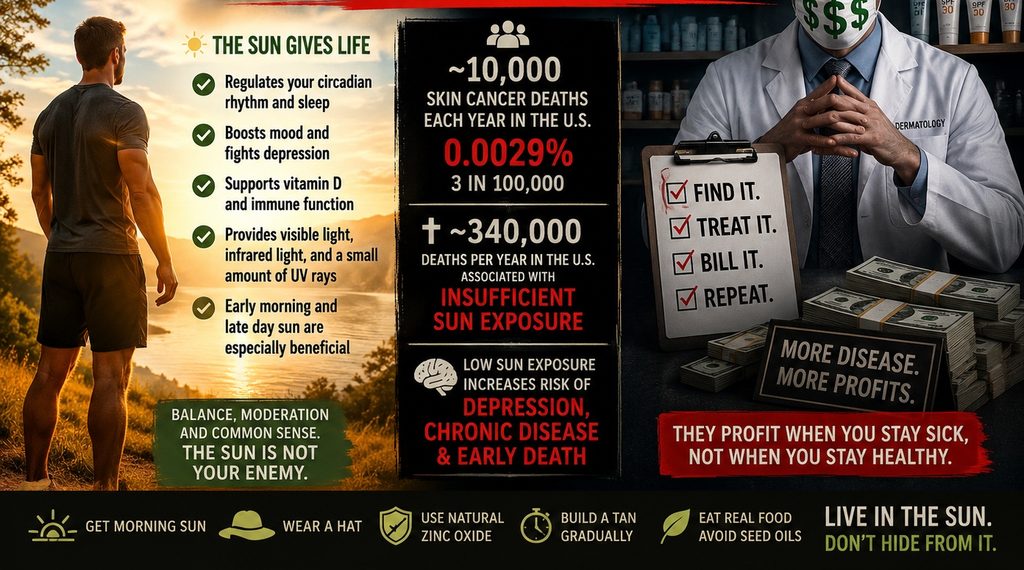
Today, there are roughly 10,000 skin cancer-related deaths each year in the United States (8,000-8,400 are from melanoma and the other Non-Melanoma (BCC/SCC) is approx. 2,000). That translates to approximately 0.0029% of the U.S. population, or about 3 people out of every 100,000 and ranks near the bottom of the list of cancer-causing deaths. But of course, it does occur but not at the rate some are led to believe and early detection is important.
Sunscreen was first developed in the 1930s. Since then, skin cancer diagnoses have increased dramatically. Many people, including myself, believe sunscreen should have caused skin cancer rates to decline (or at least remain steady) rather than rise.
Dermatology has become an industry generating an estimated $8–10 billion annually in the United States. Critics argue that the financial incentives within the healthcare system emphasize diagnosing and treating disease rather than educating people about prevention beyond the simple message to “avoid the sun.” In my view, this approach ignores important aspects of overall health.
For example, many dermatologists spend little time discussing sunscreen types and the fact that zinc oxide-based sunscreens are often considered among the safest mineral options. What do I use? Grounded Labs Raw Slath which is a pump spray and doesn’t leave your skin as chalky looking. Also, you may want to try Aloesun, Tallow Mineral Sunscreen.
In 2019 and later studies, the FDA reported that several common sunscreen ingredients, including: Oxybenzone, Octinoxate, Octisalate, Octocrylene, Avobenzone, Homosalate, and Ecamsule – were absorbed into the bloodstream (except zinc oxide and titanium dioxide) at levels that warrant additional safety testing. But of course, instead of taking them off the market until testing is complete, they bow to corporate interests and we are the test subjects.
Some laboratory studies have found that certain chemical UV filters can generate reactive oxygen species (ROS) or free radicals when exposed to UV radiation that can damage DNA, cell membranes, proteins, and can contribute to premature aging and increased oxidative stress. So, the bottom-line is don’t put the mass-produced and advertised chemicals on your skin.
Remember, this doesn’t just apply to sunscreen; most everything you put on your body ends up inside of it, including deodorant, soaps, and skin care products. As I always like to say, if you need a chemistry degree to understand the ingredients, they may not be the best choice for your body and health.
Likewise, there is an ongoing public debate about the role that diet may play when it comes to chronic inflammation and disease affecting your skin health – especially highly processed foods and seed oils.
The conversation also rarely includes the potential benefits of sensible sun exposure. Early morning and late afternoon sunlight provide visible light, infrared light, and relatively low levels of ultraviolet radiation. These forms of light help regulate circadian rhythms, support the immune system and mood, and may contribute to overall well-being.
Some critics believe that if healthcare focused more on balanced sun exposure and preventive lifestyle measures, demand for medical treatment would decrease. They also point out that many dermatology practices are now owned by large medical groups, PE firms, or investment-backed organizations whose primary obligation is to generate returns for their owners and shareholders.
Research has also examined the risks associated with avoiding the sun altogether. A 2020 review estimated that approximately 340,000 deaths annually in the United States and 480,000 in Europe may be associated with insufficient sun exposure. These estimates were based on observational studies linking low vitamin D levels with higher rates of cardiovascular disease, cancer and other causes of death. My former dermatologist continually told me to avoid the sun (I’m a golfer who lives in AZ which has the sunniest days in the U.S.) and that is why she is my former dermatologist.
In addition, a Swedish study following nearly 29,500 women found that those who consistently avoided sun exposure experienced roughly twice the all-cause mortality of women with the highest levels of sun exposure. The authors estimated that approximately 3% of deaths in that population could be attributed to sun avoidance.
Historically, hospitals commonly incorporated outdoor terraces and “sun porches,” where patients were wheeled outside to receive fresh air and sunlight as part of their recovery. Over time, medical practice shifted away from those approaches as costly modern pharmaceuticals and medical treatments became the primary focus of healthcare.
Reduced sunlight is also associated with Seasonal Affective Disorder (SAD), now known as Major Depressive Disorder with Seasonal Pattern. The condition commonly occurs during the fall and winter months when daylight hours are shorter. Researchers believe that decreased exposure to natural daylight can disrupt circadian rhythms, melatonin production, and serotonin activity, contributing to symptoms of depression.
My conclusion is simple: the sun is neither something to fear nor something to abuse. Like many things in life, moderation matters. Enjoy regular, sensible sun exposure. If you’re going to spend extended time in the intense midday summer sun, wear a wide-brimmed hat and consider using a mineral sunscreen containing zinc oxide. If you’d like a tan, build it gradually rather than trying to achieve it all at once. However, if you find a suspicious spot or something just doesn’t look right on your skin, consult a medical professional.
I’ll close with a thought-provoking observation:
When was the last funeral you attended where the person in the coffin had a healthy tan?


Join - React & Comment!
Comments